
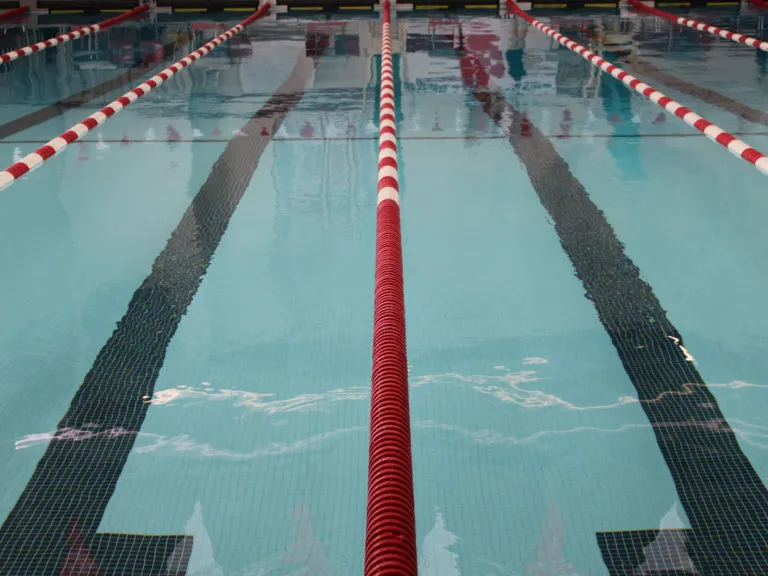
To a non-swimmer or parent, the idea that some pools are faster or slower than others seems odd.
If your swimmer is telling you that this pool is a fast pool while others are slow pools, there may be more than a few reasons why. In this post, we will explain the reasons why some pools are faster than others.
Competition Swimming Pool Design
The design of the pool is the major contributor to creating favorable conditions for a competitive swimmer.
Several factors can make a swimmer’s lane assignment a factor in swimming well.
Higher-level competition pools are almost always faster and your swimmer will likely enjoy getting their best times during those meets.
Gutter System
Newer pools have an intricate gutter system surrounding the perimeter of the pool. This allows water to be recycled back into the filtration system, but that is not the most important part.
Fast pools have a gutter design that allows waves from a swimmer’s wake to dissipate before reaching the side wall of the pool. This in turn keeps the rebounding wave from creating turbulence for the swimmer.
The waves rebounding can be enough to push a swimmer off their center line or to make pulling the water slightly more difficult.
When you are dealing with a hundredths of a second, every little factor can mean huge consequences. The swimmers in the outermost lanes are the ones obviously impacted the most.
Older pools may not have updated gutter systems and tend to be the slowest pools.
Shallow Pool Design
Some pools are designed shallower than others. While there is a minimum depth to allow for dives, different facilities may have reasons to make pools much deeper.
Typically financial concerns are the leading factor in determining pool depth. Deep pools are more costly to both create and maintain
Shallower pools act similarly to pools with poor gutter systems. Waves can rebound off of the bottom of the pool and disrupt the swimmer.
Similarly, shallow pools don’t disperse waves like deeper pools. This can slow a swimmer’s momentum and make it feel slow.
Pool Return Jet Position
The return pool jets bring water from the filtration system back to the pool. These jets are more forceful with larger pump systems for obvious reasons.
Swimming alongside powerful return jets can push a swimmer off their centerline. The swimmer may feel like it takes more effort to maintain a straight line, giving them a disadvantage.
Properly built and placed return jets shouldn’t impact a swimmer, however, this is not always the case.

Competitive Swimming Pool Temperature
Warmer pools can relax the swimmer’s muscles and cause them to overheat, making them feel weaker and more tired. Conversely, colder pools can cause cramping and be just as much of a problem.
Maintaining the optimum temperature for competitive swimming is vital.
Pools should be between 77 and 82 degrees according to World Aquatics, but that’s not always the case with local pools.

Starting Blocks and Wedges
Blocks and wedges can make a huge difference. There are strict standards for higher-level competitions, but in school pools, you are likely to see a variety of setups.
Some blocks are equipped with a starting wedge, while others are simply a tilted, flat surface.
Swimming on unfamiliar setups can make a swimmer slower.
There are a lot of factors that can make one pool faster or slower than another and most will have a reputation among the local swim clubs.
Even though it sounds ridiculous, there is a lot of merit to your swimmer’s complaints!
